// case study · search infrastructure
Search the web before the AI web changed it.
Cryo searches a frozen pre-2022 corpus with lexical retrieval, semantic reranking, provenance, and agent-ready interfaces.
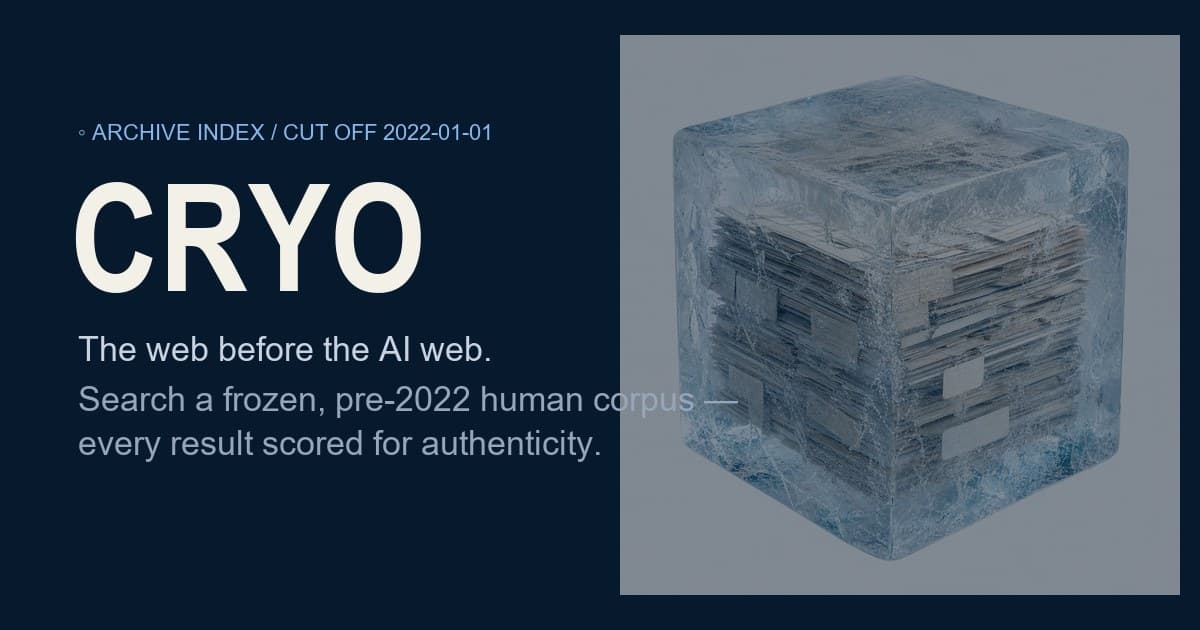
The public web is increasingly mixed with synthetic material. Cryo explores a narrower question: what if an agent could search a source-bounded snapshot from before that shift, while still using modern retrieval interfaces?
Retrieval pipeline
- Meilisearch produces fast BM25-style lexical candidates.
- Qdrant stores embeddings used for semantic retrieval and reranking.
- Results retain source provenance and capture timestamps rather than flattening pages into anonymous chunks.
- An authenticity score surfaces how well each result fits the corpus boundary.
pre-2022
Corpus boundary
source-bounded frozen snapshot
2
Retrieval modes
lexical and semantic
4
MCP tools
agent-ready search access
Interfaces, not a closed demo
The same retrieval path is available through a FastAPI service, a typed Python SDK, LangChain and LlamaIndex integrations, and four MCP tools. That lets a person inspect results in the web interface while an agent uses the corpus through a structured tool contract.
What Cryo does not claim
Cryo is a research-grade retrieval system, not a web-scale archive or a claim that older sources are automatically correct. The useful property is the explicit temporal boundary and provenance: users can see where a result came from and decide how much weight to give it.